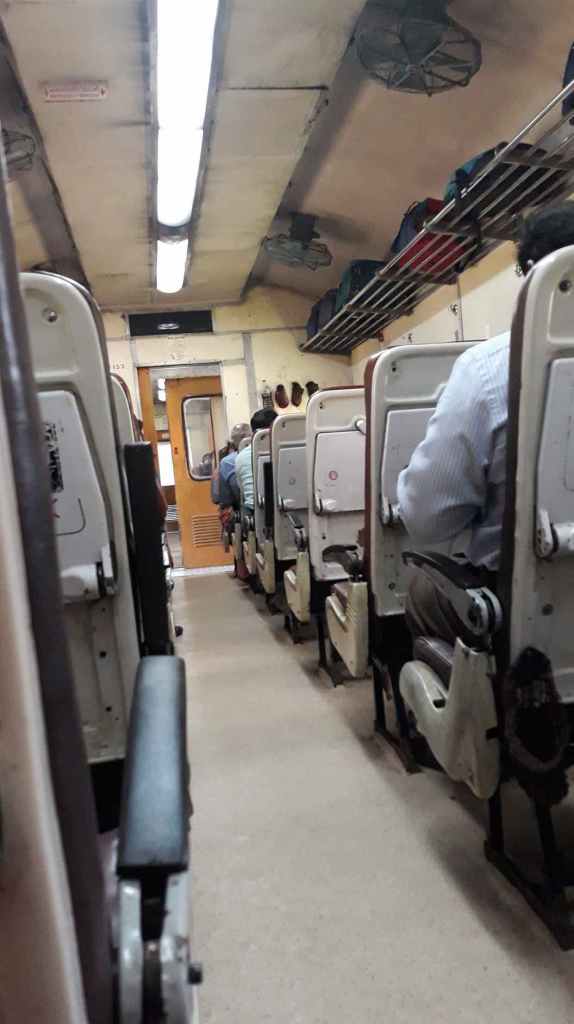
A central hallway, and on either side of rows of three brown leatherette seats. It’s polar cold, the air conditioning has to be turned up to full blast, and that doesn’t bother the natives sitting here and there, most often with their families, spending the time of the trip talking or catching up on sleep. A few of them are looking at their smartphone or their computer. Others, rarer, read the newspaper or a book. The seats look a hundred years old, as if each of the one billion Indians had travelled there one day. The brown skai is faded, but it’s solid. The shelves are made of metal, strong as well, which have probably been tested by the elephant, not without damage, but not without resisting, and they still render, and for a long time, the service for which they were designed. The windows are small, double-glazed, with a big rubber seal that goes all around them, like the overflows from the last painting of the car. Through this screen, a tropical landscape slowly scrolls by, green, green again, sometimes houses, cars, tuk-tuk, motorbikes, scooters, bicycles and pedestrians. On the ceiling, six huge fans, but inactive, we are in winter. The luggage rack, running along the wall, above the windows, very small in proportion to the car, but filled with all kinds of parcels and suitcases. The train slows down, then appears the platform of a station with an unpronounceable name.
Par Jean-Yves
Translated with http://www.DeepL.com/Translator (free version)
 Rencontres et découvertes, ici et ailleurs