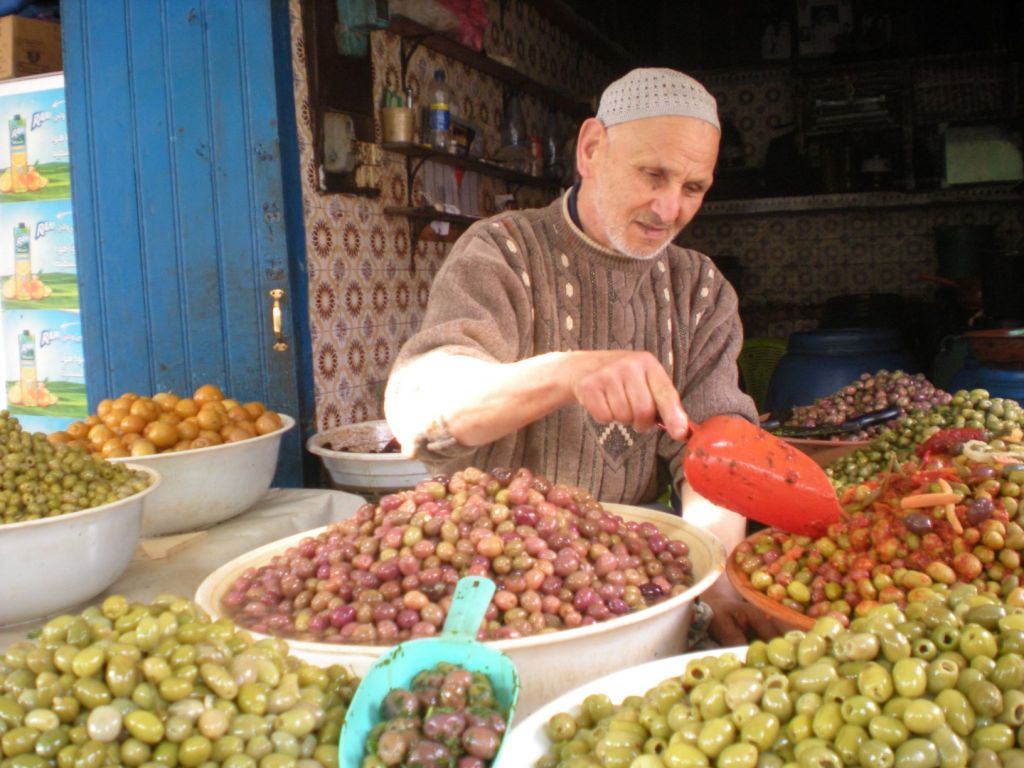
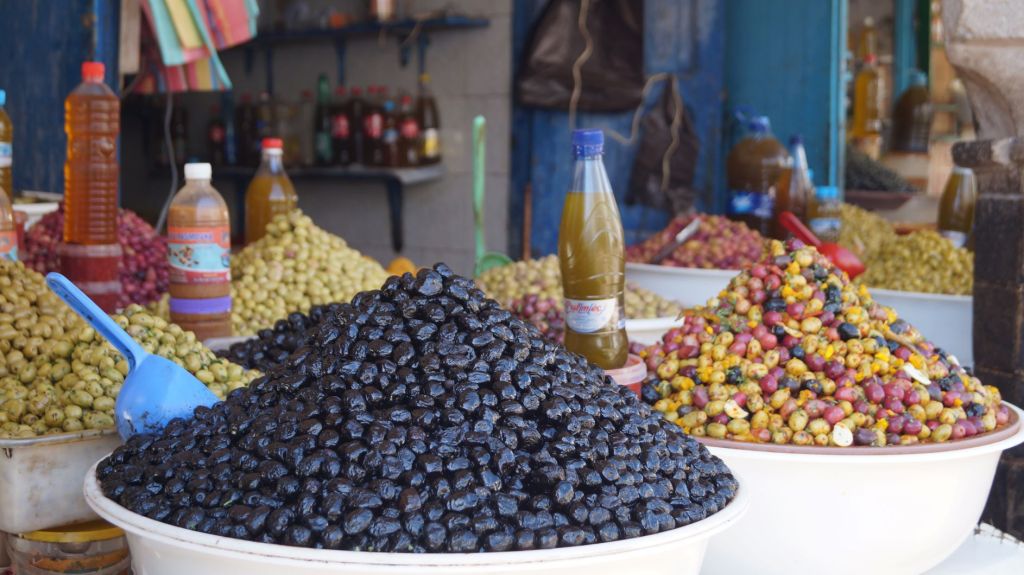
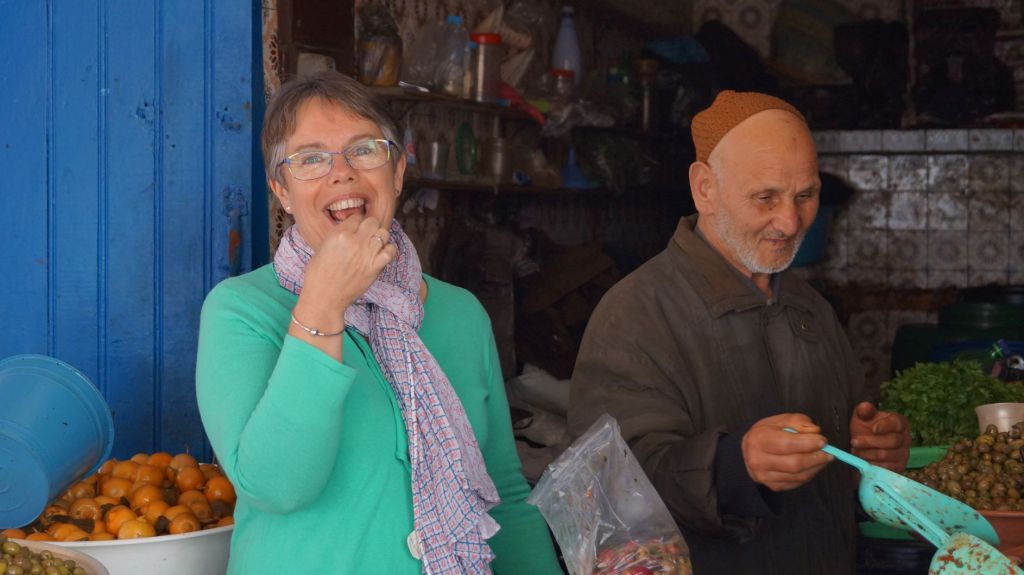
Like every morning, she goes shopping, with her friend Souirie, in the souk located in the heart of the Medina of Essaouira. First, they plan to go to the olive merchant. The one who runs the small shop, at the very beginning of the Mohamed Zerktouni Avenue and who always wears her most beautiful smile. A small, well-cut goatee, a mole under his left eye, his hands are always shiny from dipping them in olive oil. He serves his customers with love and revels as soon as he sees them tasting his olives. He is so generous that he adds at least twice as many olives, once they are weighed, to make you a little gift. His olives are presented in the form of well aligned cones. It is a delight for our eyes as Europeans in search of beauty.

Below his shop, along the sidewalk, the porters are waiting to be hired. They are well lined up along the street and they are guessing about the current events of the moment. Here, it is the best way to be delivered given the narrowness of the streets. There is no access for cars. This is what makes the charm of the Medina. Some hotels, restaurants use these carts to advertise themselves and compete in originality to put themselves on stage. On one of them, all blue painted, we discover a road sign indicating Essaouira Wind city, Essaouira la cité du vent.

The avenue is starting to come alive, now we have to move up the shopping list. Her friend Souirie reminds her to buy a lemon to season the tomato salad. They enter the famous fruit and vegetable souk. Some Americans are there with their camera. They seem completely confused. It has little to do with their famous shopping malls, a temple of consumerism. Here, people take the time to choose, to taste. It’s an unchanging place, in which there is a very special atmosphere. There is the tea merchant who constantly heats his kettles and whose young waiter crosses the market in all directions to bring to the shopkeepers and customers, the beverage that celebrates friendship.


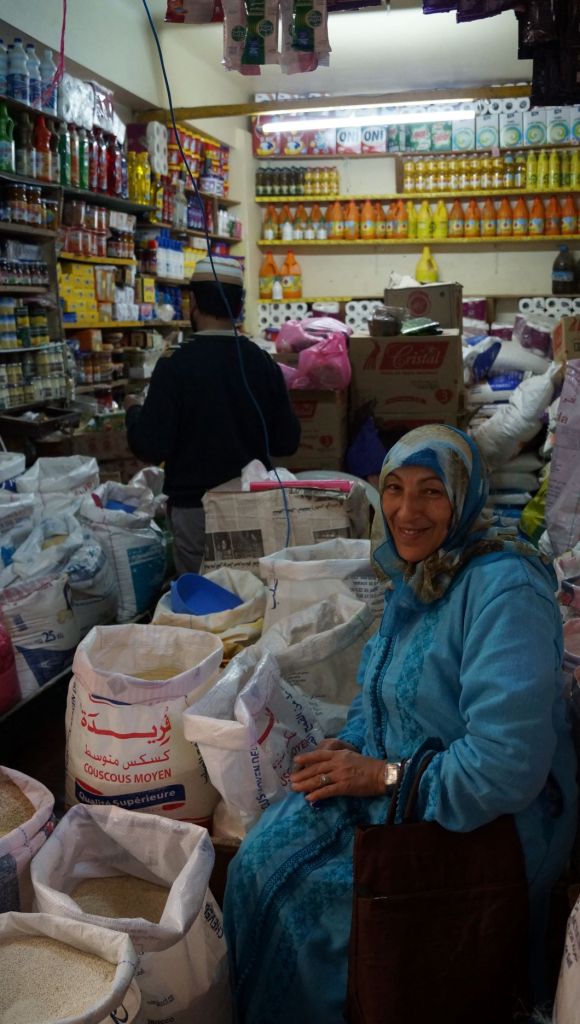
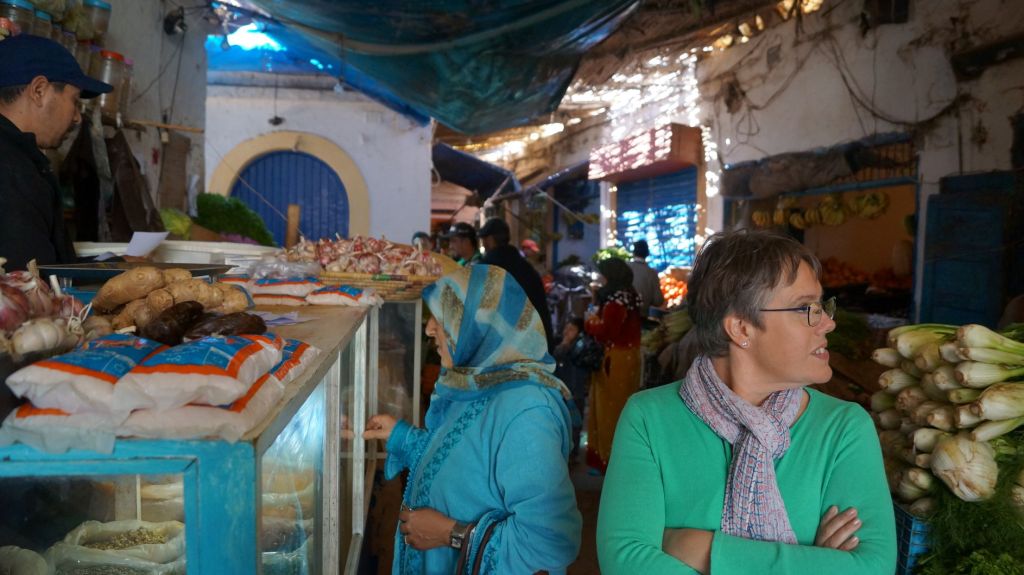
At the entrance to the souk, her friend Souirie orders 30 g of freshly ground cumin, 20 g of coriander and 50 g of turmeric. It’s for today’s cooking, they’ll come back tomorrow if necessary. What’s the point of buying too many spices all at once? They would risk fanning out, when it’s so simple to get supplies on a day-to-day basis. At the second newsagent’s on the left side of the souk, she tastes the tomatoes with her expert hands and then tastes the peas. There is no question of buying just anything either. This has nothing to do with the frantic pace at which Europeans shop in the shops. A little further on, she doesn’t forget to take 100g of vermicelli for the Moroccan soup in the evening. Then she sits for a few minutes on the bags of semolina to ask about so-and-so. The merchants are patient and also appreciate being able to exchange a few moments. In the meantime, our European is enjoying the small colourful stalls with all kinds of fruits and vegetables. A young greengrocer throws the brightly coloured plastic baskets, patched up countless times, from his counter to the smiling housewives lining up in front of his stall. The European doesn’t understand much about trade, but that doesn’t matter; time passes differently in the Medina. She knows that the meal will be good, that she will find the taste of the oranges of her childhood, that there will be seeds in the oranges and that the pods of the peas will be well garnished.
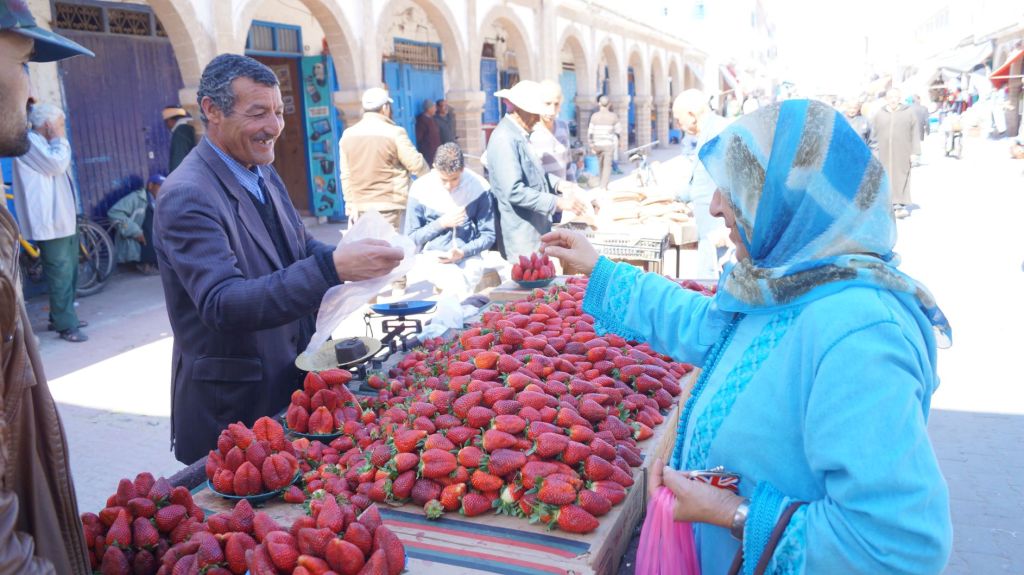
The time has come to get out of the souk and return to Avenue M. Zerktouni. The street vendors are now all settled and their stalls are loaded with flat breads, fish, dates … strawberries also just arrived from the plain of Agadir. How can you resist the charming smile of the salesman?
On the way back, they pass through the small streets, in front of the café at Soufiane’s, where the cook prepares the tajines, which the fishermen will come to taste on their return from the port. Our friend souirie drops off the groceries in the Riyadh and hurries off again because she is already late. It’s 10 o’clock, time for the European and her companion to get lost in the Medina. At the exit of the Riyadh, they meet a young child who is waiting for his mother, leaning against the wall, on which an artist has painted a huge cat with whiskers. His mother lines up at the pastry shop across the street, where cream cakes cost only 30 cents. On the floor, a red and white cat eats the leftovers of a chicken, which have been put there for all the cats in the neighbourhood.

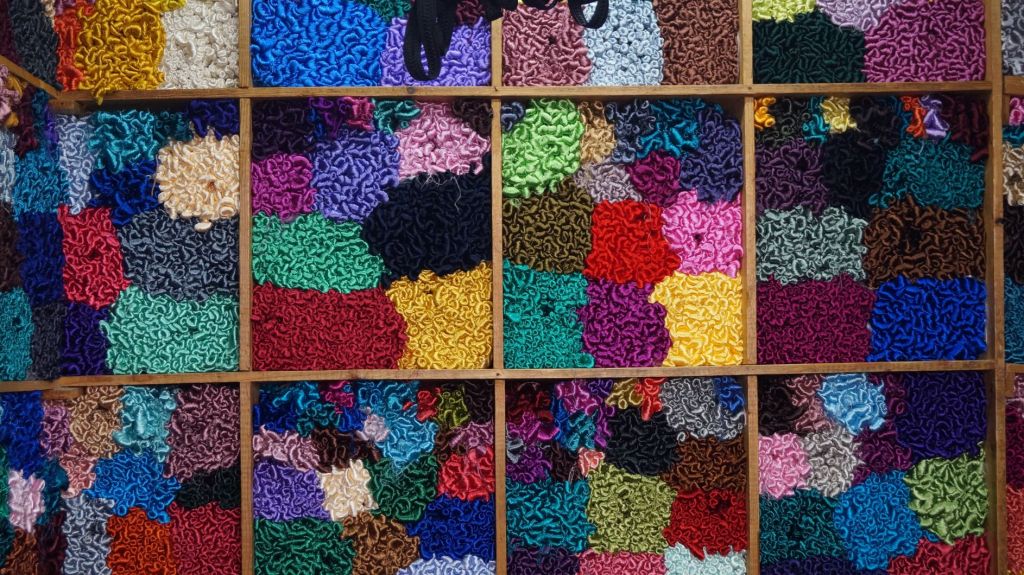
Our friends choose to take the Ibn Khaldum street, the one that overflows with life around 1 p.m., just after school. For the moment, it is rather quiet, and they can stop to admire the silk thread merchant’s shop. They rave about the thousand and one threads skillfully arranged, which form multicoloured micro-waves. It is with his threads that the weaver, whose shop is a few metres away, will make the colourful drapes that decorate the alleys. As they walk down the street, the threads stretched between the various shops get tangled in their hair. They are careful not to disturb the artists at work and exchange a few smiles.
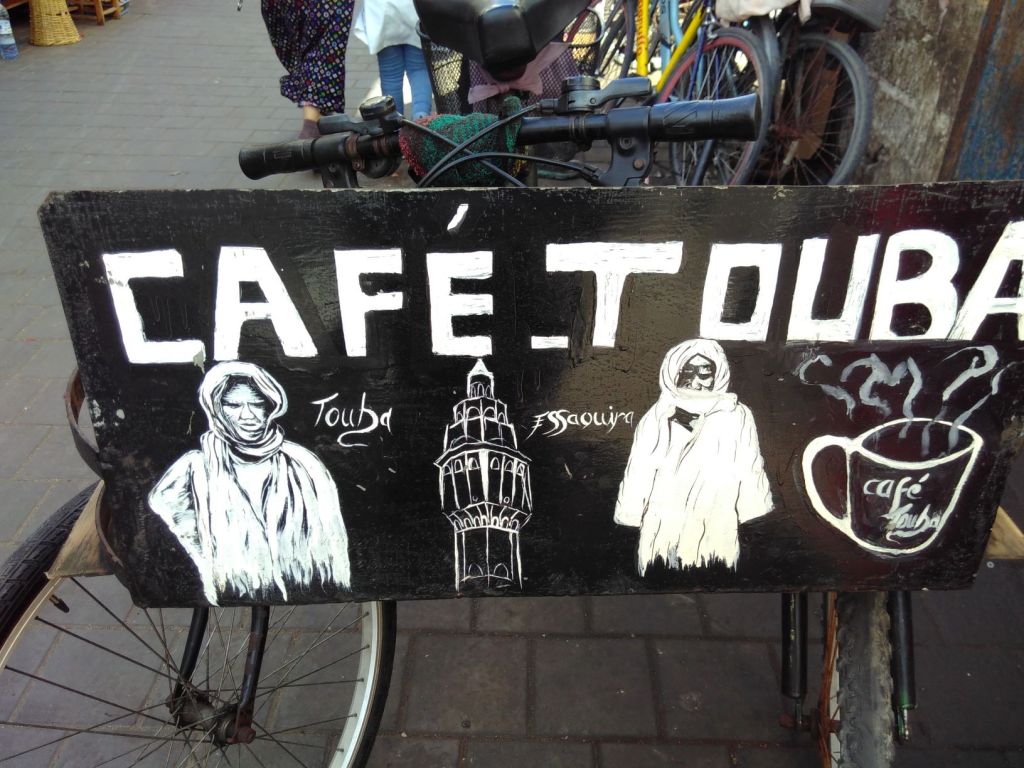
At the end of the Ibn Khaldum street, they go to the left, on the side of the Baab Marrakech, to finally join the landscaped alleys, just behind the Borj Bab Marrakech. On the way, they pass the itinerant tea vendor of the Touba café. He is recognizable by his three-wheeled bicycle, repainted in black and white and loaded with teapots and cups.
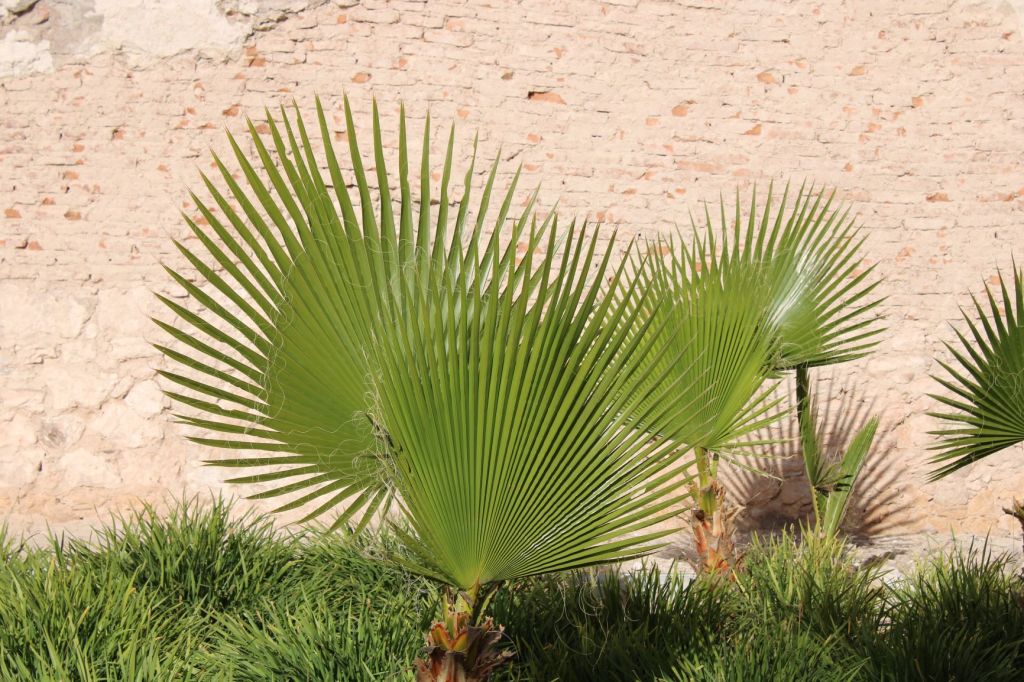
In the landscaped alleys, the gardeners are at work weeding the beds at the foot of the palm trees. There are three of them, proudly wearing their new orange and green outfits. Fan-shaped dwarf palms undulate in the light breeze. Behind them, we can see a pretty blue door well inserted in the old wall. We feel like opening the door a little bit to discover what we imagine to be a haven of relaxation.


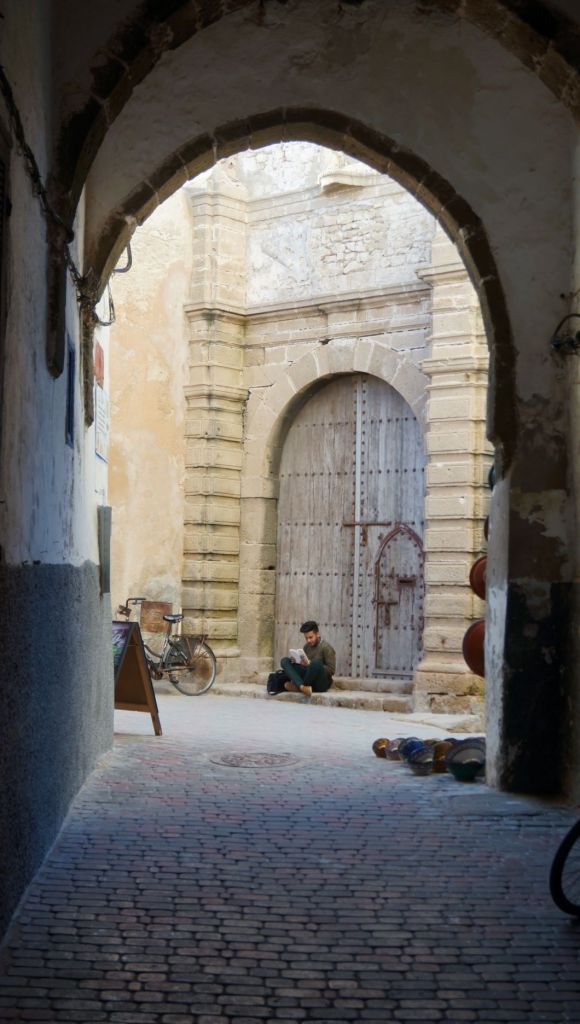
The sun is shining brightly and it is time to go to the more shady streets of the Medina. On the steps of a centuries-old doorway, a young man is immersed in a novel. He is so absorbed by his reading that the passers-by, who keep coming and going in front of him, do not even disturb him.
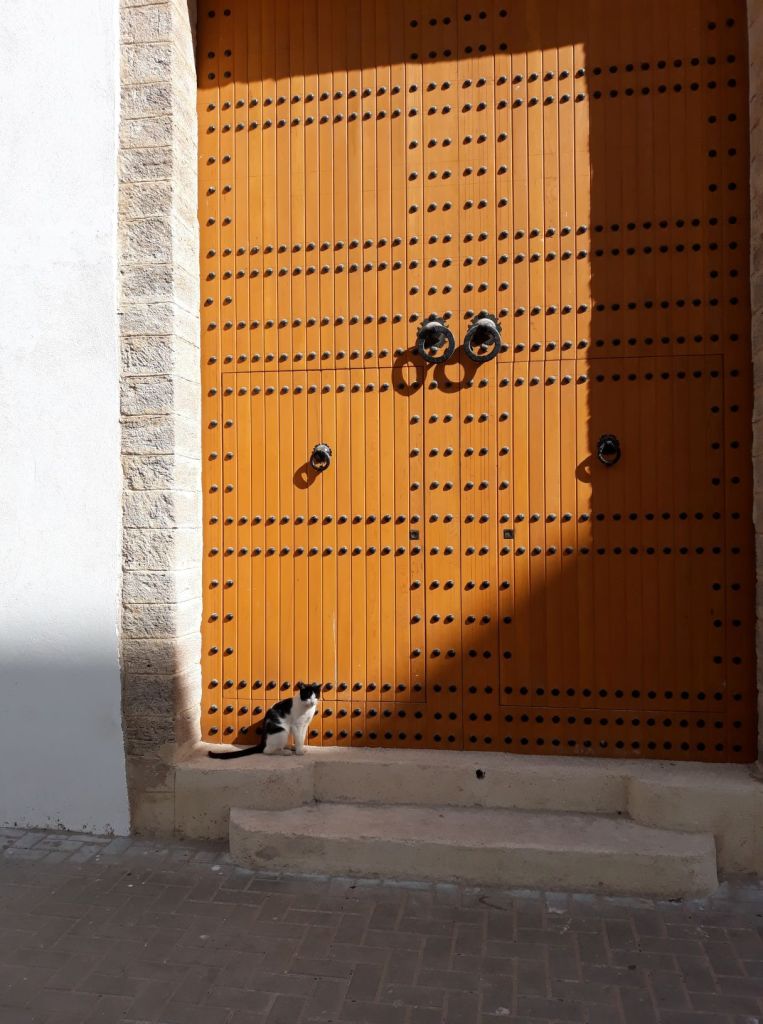
Our travellers then make a quick passage through Cairo Avenue to admire the restoration work carried out on the buildings at the corner of the street. A few meters away, in front of one of the tastefully restored doors, a little cat is squeezing into the only corner still in the sun. In this area the shade has regained some ground. The Medina gives us an eternal fight between the shadow and the sun. Each corner invites us to guess which of one or the other will have taken over. In front of the tourist office, a man with a black and grey striped burnous has pulled up his pointed hood to protect himself from the coolness in the shade of the high walls. Meanwhile, a porter delivers the precious argan oil to the women’s cooperative that is installed in the middle of the street.
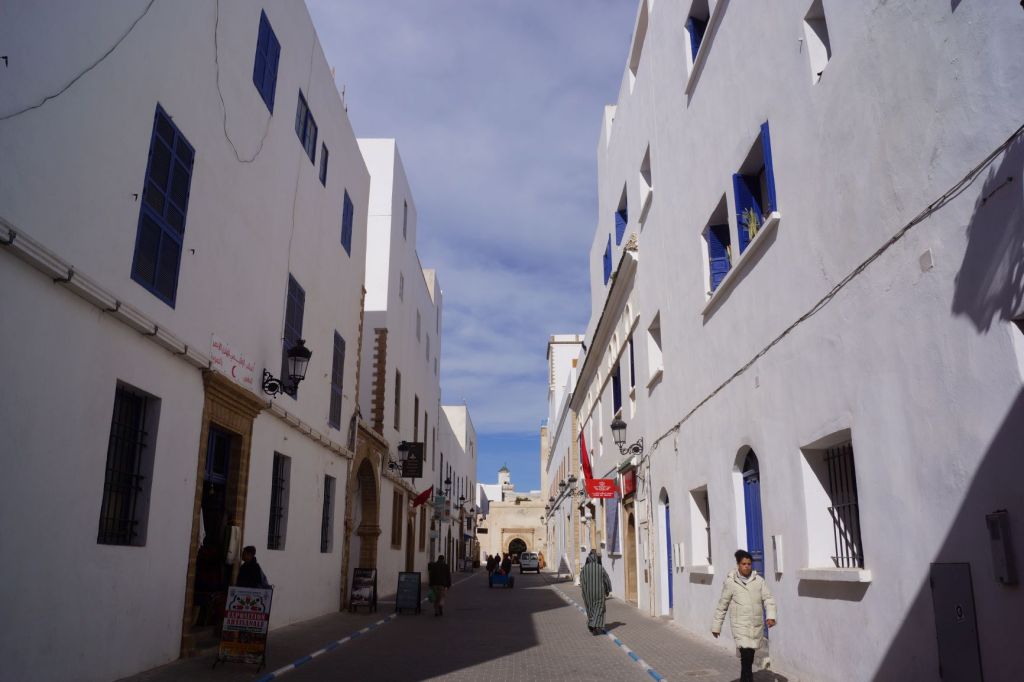
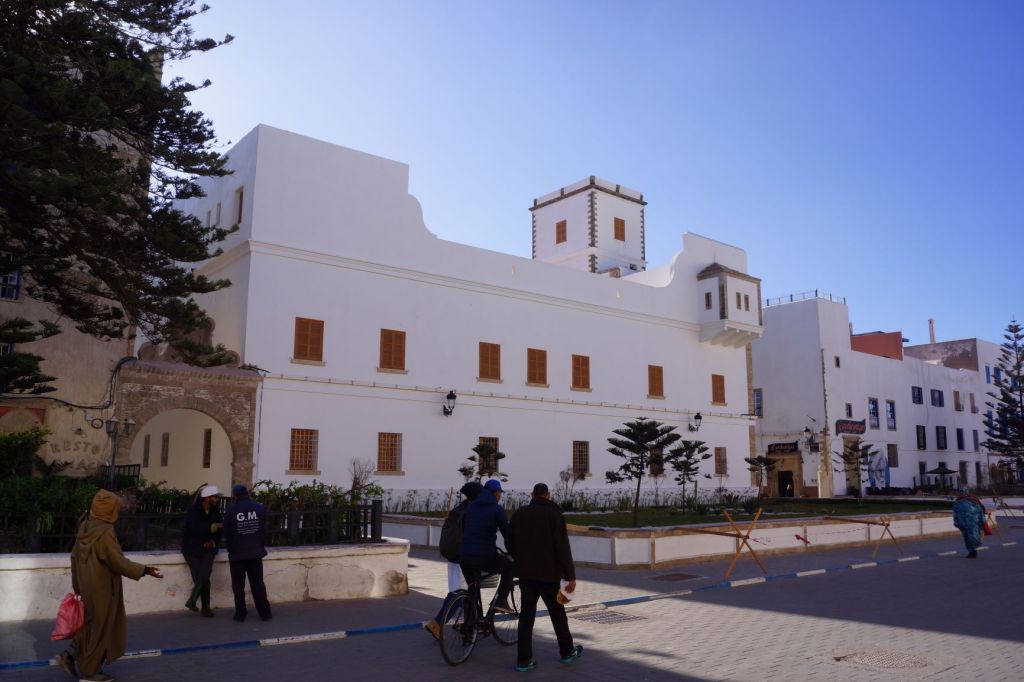
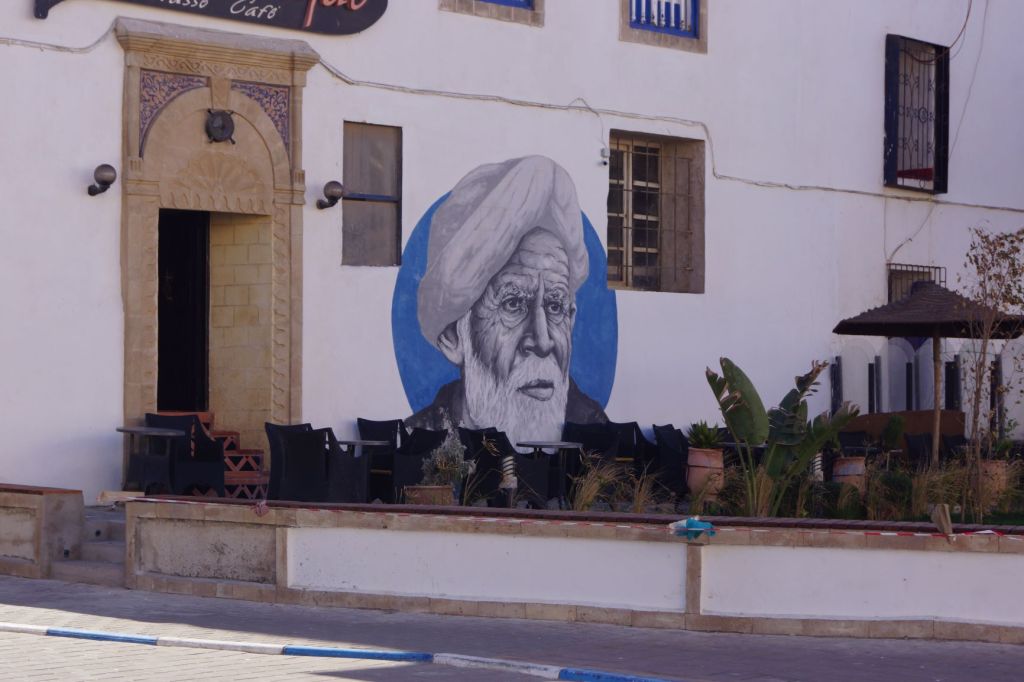
On the other side of the street, through the small door, you can guess that the Hamad pharmacy is open. On the small square, now shaded, a few tourists are sipping a drink at the clock café. The corner is peaceful and restful.
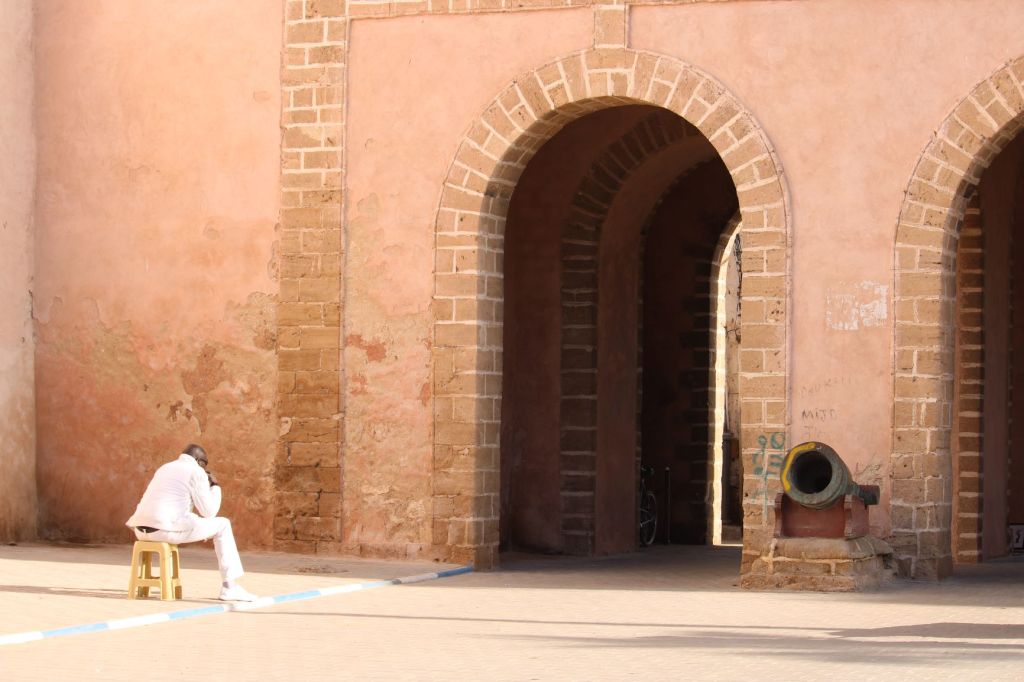
After some hesitation, our friends prefer to go to the three gates, in Oqb Ibn Najraa Avenue, which is still sunny. An African man, dressed all in white, is meditating. He is sitting on a small yellowed plastic bench, facing the cannon sealed in front of one of the doors. What is he thinking about right now? His clothes are dazzling in the reflections of the sun and contrast with the shadow that can be seen under the double doors.
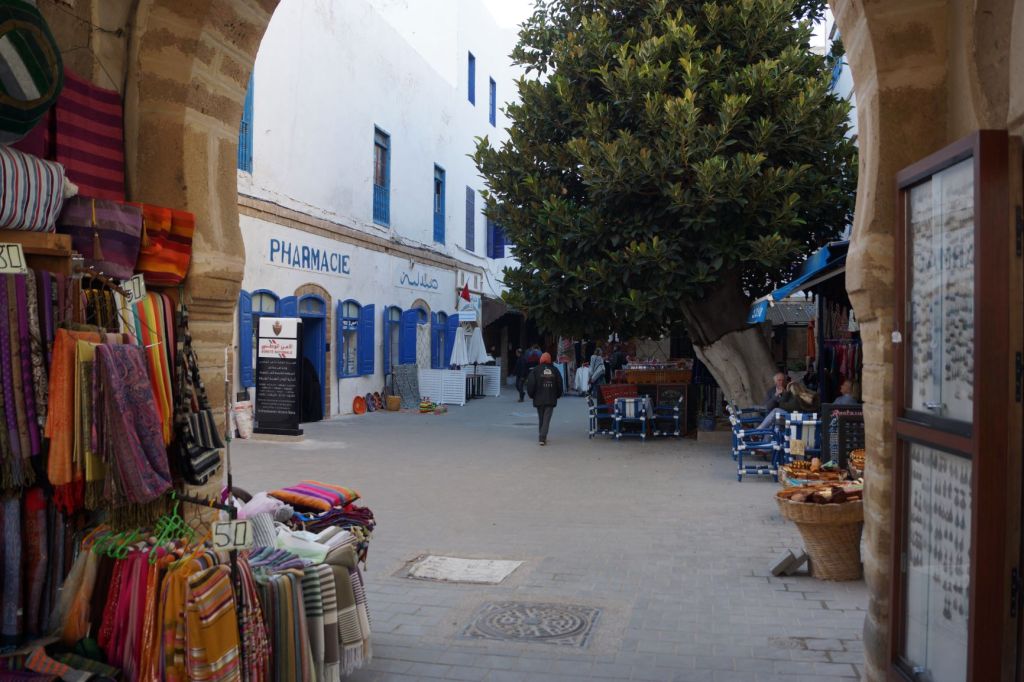
The gates are crossed, and despite the works around the corner, our travellers decide to take Al Atarine Street. It must be said that she saw, on the left side, a very colourful display of slippers. She doesn’t forget that they have orders to fill…
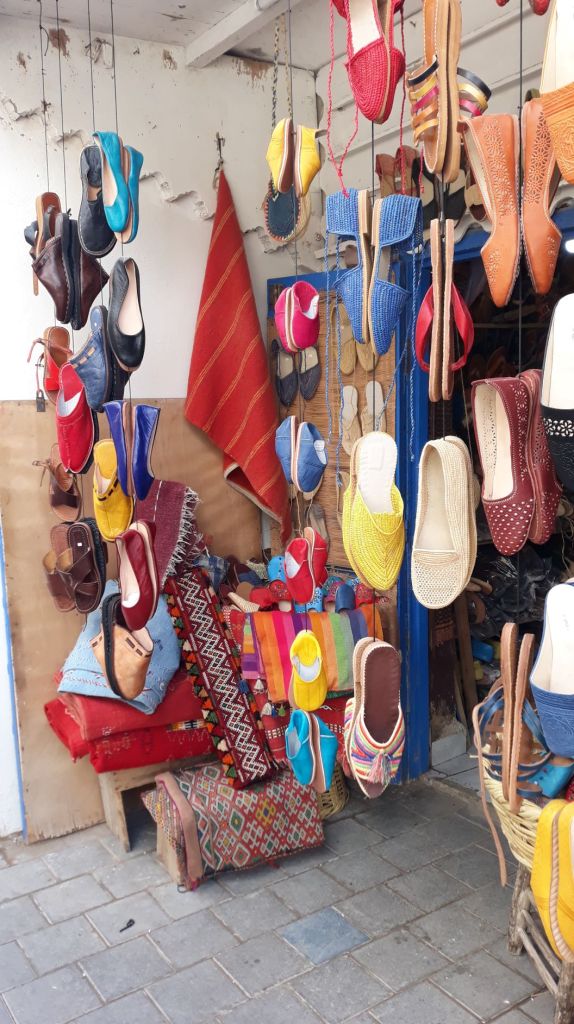
The shop has a nice name, it’s called « The Hand of Fatma ». The stall is neat. Her companion, for his part, quickly spotted some pretty earrings that he would like to give her as a present. He knows that she loves blue more than anything else. He sees two pairs of intense turquoise blue earrings in the window. These would match perfectly with his girlfriend’s eyes. These eyes under whose charm he falls every time their eyes meet. He now has the sharp eyes of men who like to offer the little surprises they have found in artisans here and there. He never makes mistakes in his choices. What’s more, for once, the salesman doesn’t rush them to force them in. That’s a good sign. It’s time to come in and get to know each other.

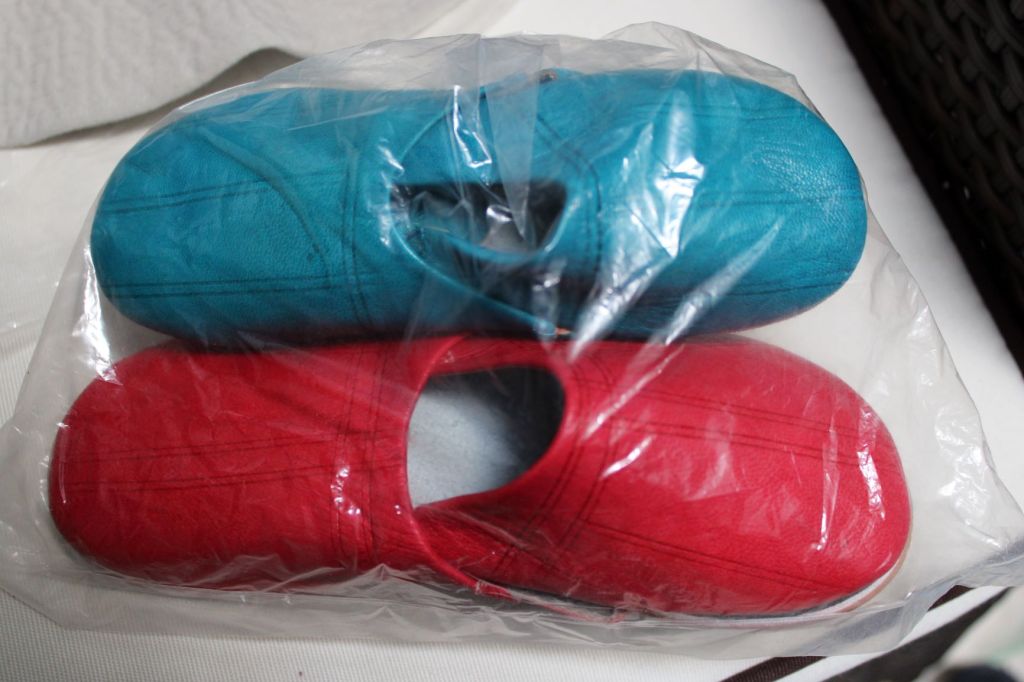
In a matter of seconds, the link is established. The shopkeeper struggles to find the sizes of slippers that match the desired colors. A pair of 16 blue and a pair of 18 red for one of their grandsons, a pair of 38 turquoise blue and two more pairs for the family in Switzerland. As a good merchant, he takes the opportunity to present a pair of worked slippers with a small heel. They are irresistible and very comfortable, of course… The young shopkeeper’s name is Amine and he is very friendly. He carefully wraps all the slippers, then presents with delicacy the earrings. He also gives some good advice.
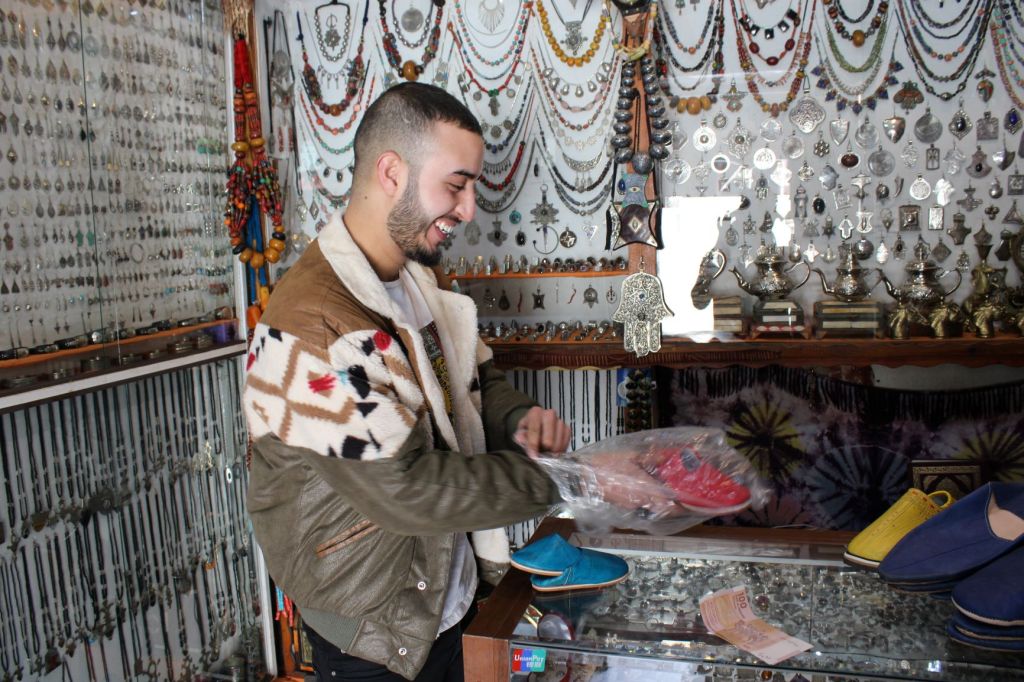

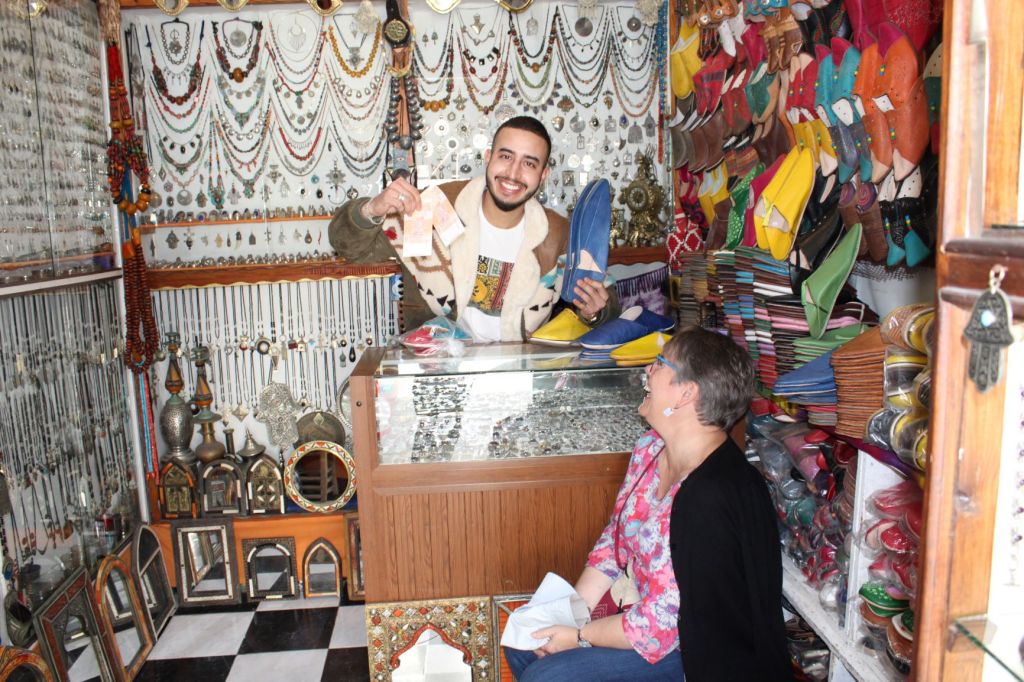
Once you’ve made your purchases, it’s time to exchange a little more and share a few jokes. And one thing leading to another, he shares his dreams and projects with them, as they tell him about their lives and their struggles in Europe, in favour of a more united world. The exchange is really very nice, sprinkled with humour. It must be said that their host is exceptional and knows how to handle humour with tact. He then entrusts them with the shop, the time to fetch a tea around the corner.

It is always tea time in the Medina and this moment is precious. They come to wonder how their supposedly civilized world could have tipped into such a frenzy of speed. This speed that so often leads to not knowing how to take the time to taste, to savour, to soak up the good moments shared. The Medina and its salesmen, like Amine, give them a beautiful lesson of humanity, allow them to enter another temporality, the one where human relations and exchanges are privileged over profitability.
Par Nathalie
Translated with http://www.DeepL.com/Translator (free version)
 Rencontres et découvertes, ici et ailleurs