from Bandipur to Ramkot, guided by Roshan

It’s dawn in the charming village of Bandipur, about which I’ll tell you more in a later article.

In the early morning mist, the villagers start to get busy, exchanging the usual courtesies. We are surrounded by mountains, but for the moment they remain invisible to our eyes: the horizon is completely blocked by the morning mist.

We enjoy a breakfast of local honey and…We enjoy a breakfast of local honey and…

They suggest that we take it quickly so that we can leave without delay, as the sun is about to arrive and is sure to burn our skin and make us thirsty. Well restored by this succulent porridge, we have enough to last the whole day’s hike, which is shaping up nicely.

As we leave the village, the sun has already risen and Roshan, our mountain guide, invites us to look to the right. It was a wonderful surprise to discover the Himalayas looming up on the horizon – a first thrill for both of us!

Beyond the espalier crops lie the majestic snow-capped mountains, which we will get even closer to on our trek to the Annapurna mountains in the coming days.Beyond the espalier crops lie the majestic snow-capped mountains, which we will get even closer to on our trek to the Annapurna mountains in the coming days.

Today is just a warm-up. Let’s get climbing! A group of Germans are ahead of us. The slope is already very sunny and we’re beginning to understand why they warned us about the heat.
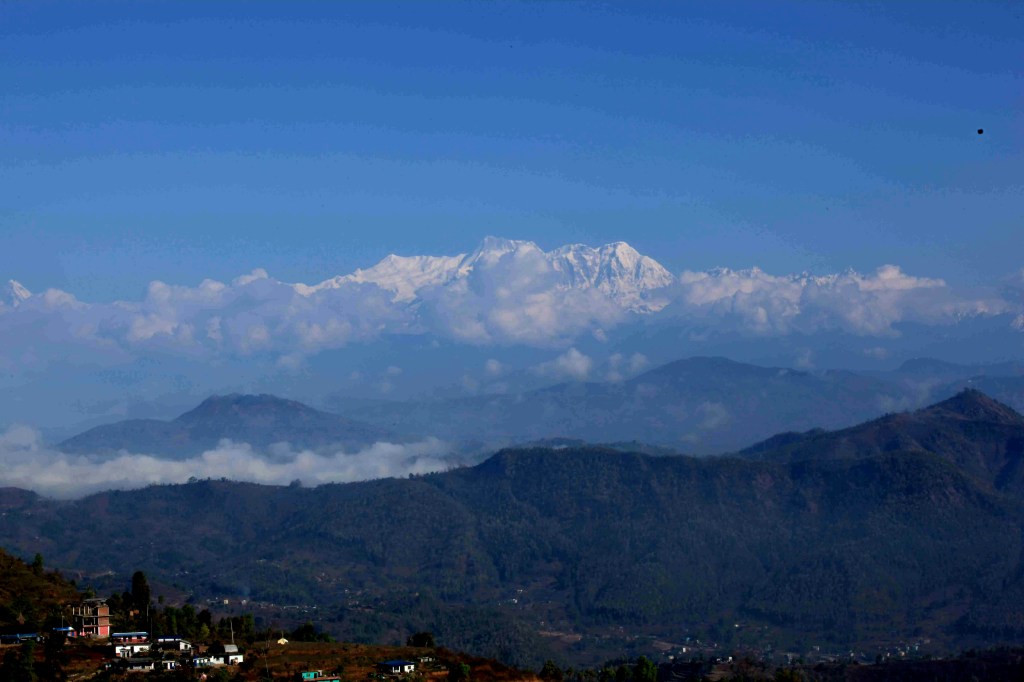
The climb unfolds peacefully, buoyed by the majesty of the scenery all around us. Roshan is really very pleasant. He regularly gives us information about the climate, local life and landscapes. A supply teacher, he hopes to be given a permanent post soon. He will soon be sitting exams in Pokhara, the district’s main town. We share our hopes for a fairer and more equitable world. The exchanges are peaceful and give us a better understanding of the philosophy of life in this wonderful region.
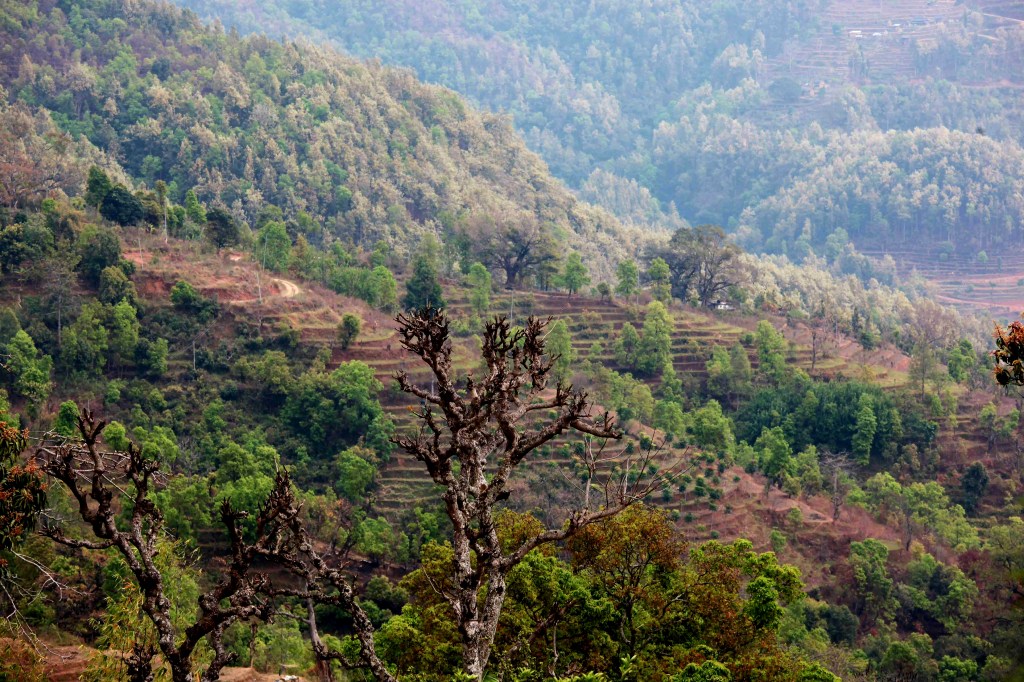
The slopes on the left are magnificent for those who love mountains sculpted by espalier crops.
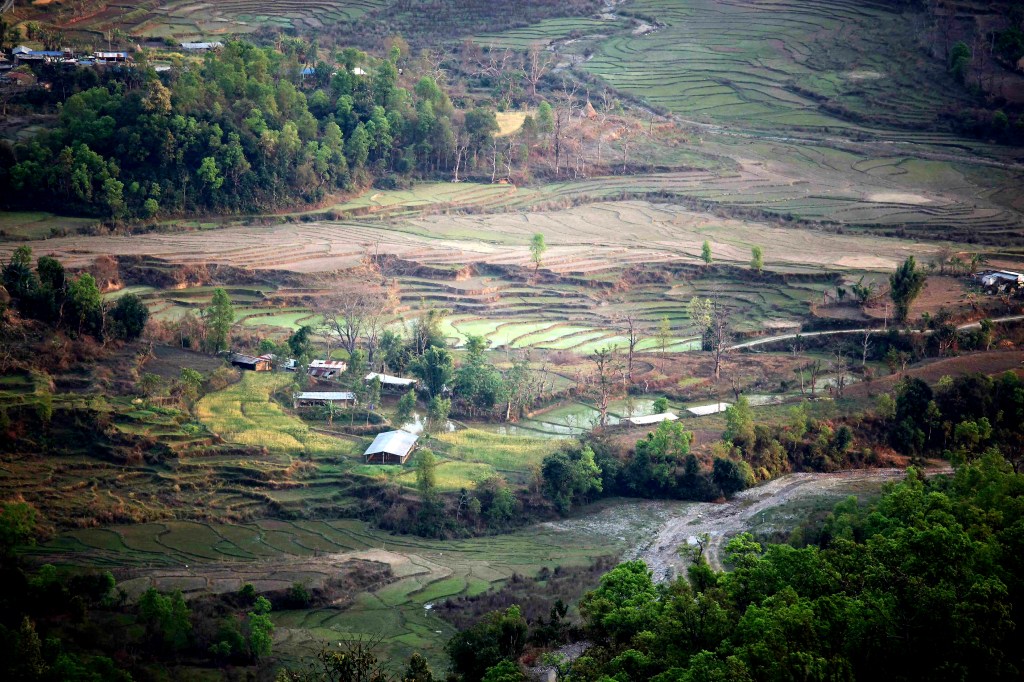
Here and there, in the large valley, a few isolated houses.
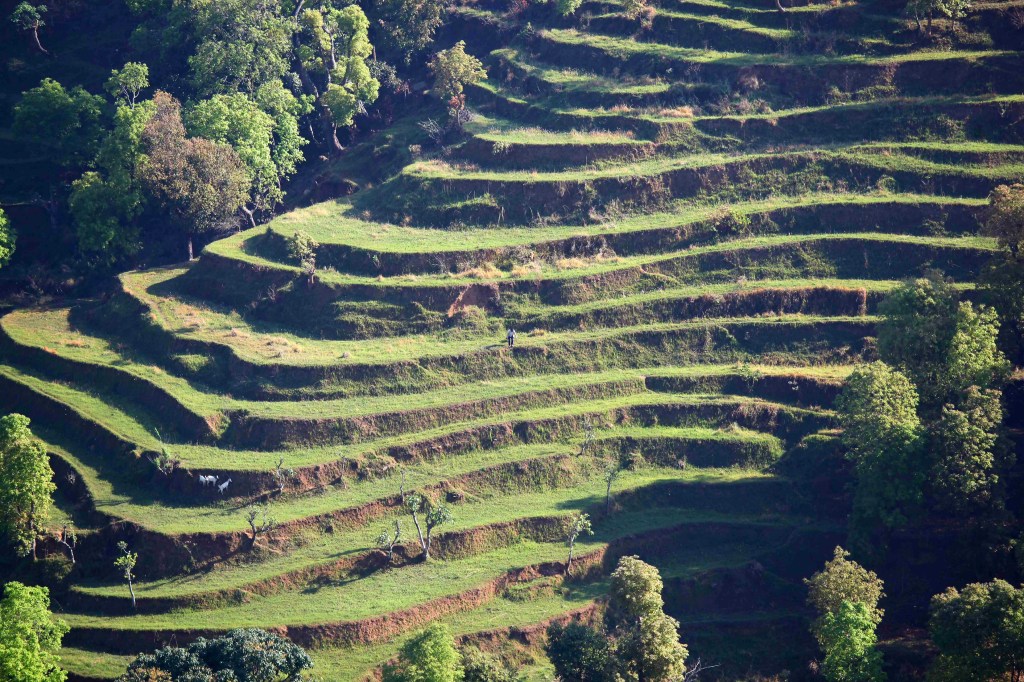
Here a shepherd and there a few adventurous goat kids. It’s up to you to find them!
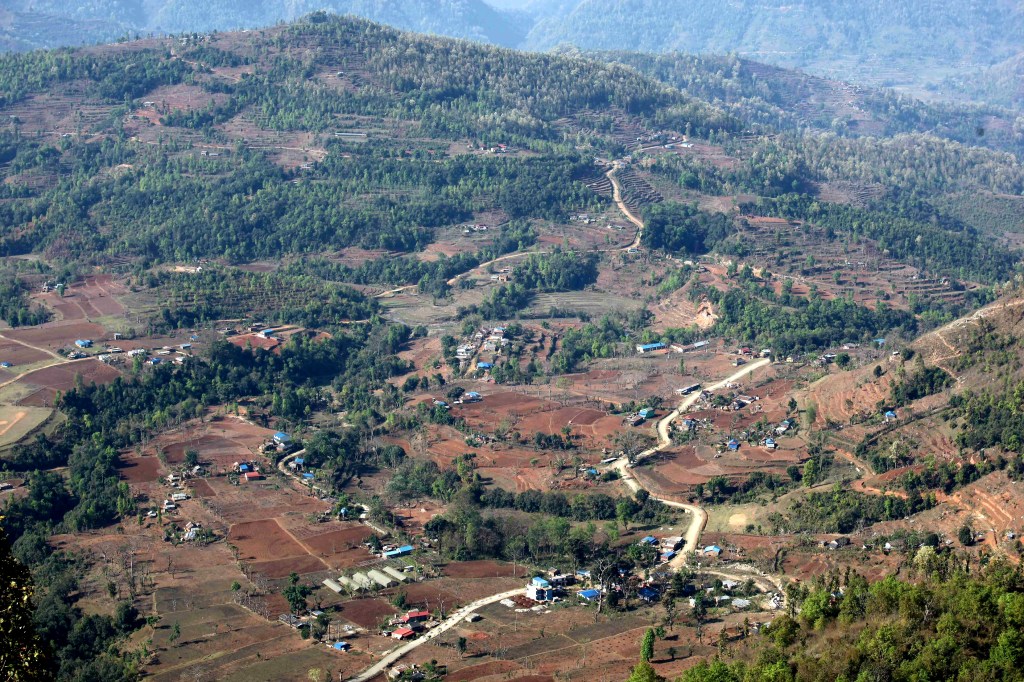
The road that criss-crosses the valley below is also the one that leads to the school. A single bus runs along it every morning and evening. If you don’t catch it, you’ll have to walk for two hours to get to school.

I follow in Roshan’s footsteps so I don’t miss any of his explanations, and I match his pace for the climb.

After a few bends, we meet a shepherdess. We’re beginning to enter another world and we have a feeling that we’ll be meeting some wonderful people over the next few days.

In the field below, a woman is working the land with her small hoe.

We chat a bit, share a few smiles and admire her stamina and know-how. We ask her if she’ll let us take a photo of her. No problem, although she doesn’t think she’s beautiful, which is not our opinion, because she is, of course, magnificent!

If you take the time to observe carefully, all around you, farmers are busy ploughing and preparing for sowing.

Roshan, when he feels that tiredness is slowing us down, offers us little breaks during which he introduces us to the wonders of nature. Here, an ephemeral tattoo made from ferns: isn’t it simply magnificent? Here, we know how to make the most of the present. There’s no rush, we’re living in the moment

The higher we get, the more fascinating the landscape becomes.

We walk for a while in the company of a shepherd and his flock. I feel like a shepherdess! We’re a long way from our Parisian lives. It gives me courage to reach the village of Ramkot.

When we entered the little village, we were surprised by how quiet it was. Most of the inhabitants are out in the fields. The peace and quiet didn’t stop us from falling under the spell of the place, even if a few joint pains in my right leg spoiled the moment a little. But my mind, increasingly occupied with discovering the thousand details that surround us, ends up making me forget the discomfort.

We take a tour of this typical Magar village with its traditional houses. An alchemy of colours, low houses with shelters all around, it’s extra. This village is still preserved from modernity.

Each family has its own beehive, which hangs over the entrance to the house. We watch as the bees come and go, patiently making the precious nectar.

We then arrive at the home of Roshan’s friends. They live in a traditional round house. We find out how the flour mill still works.

Chandra’s family gave us a very warm welcome, a cup of tea and wonderful smiles. Kindness bursts from their eyes.

A very pleasant moment of exchange which we will keep excellent memories of even if we do not speak the same language.

Whatever their age, everyone has their own tools to work the land. We are entitled to a demonstration.

We are won over.
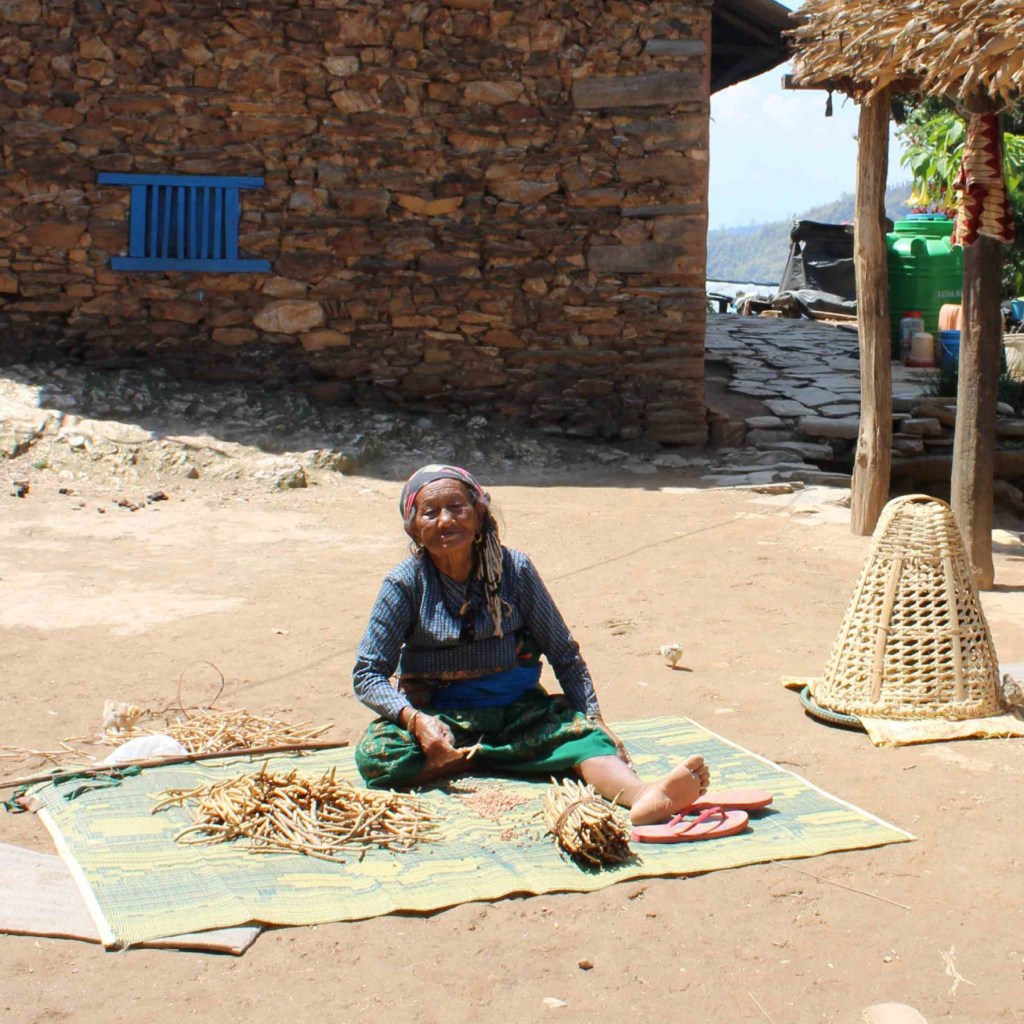
Just after leaving Roshan’s friends, we meet an old woman who shells large dried beans for the winter.
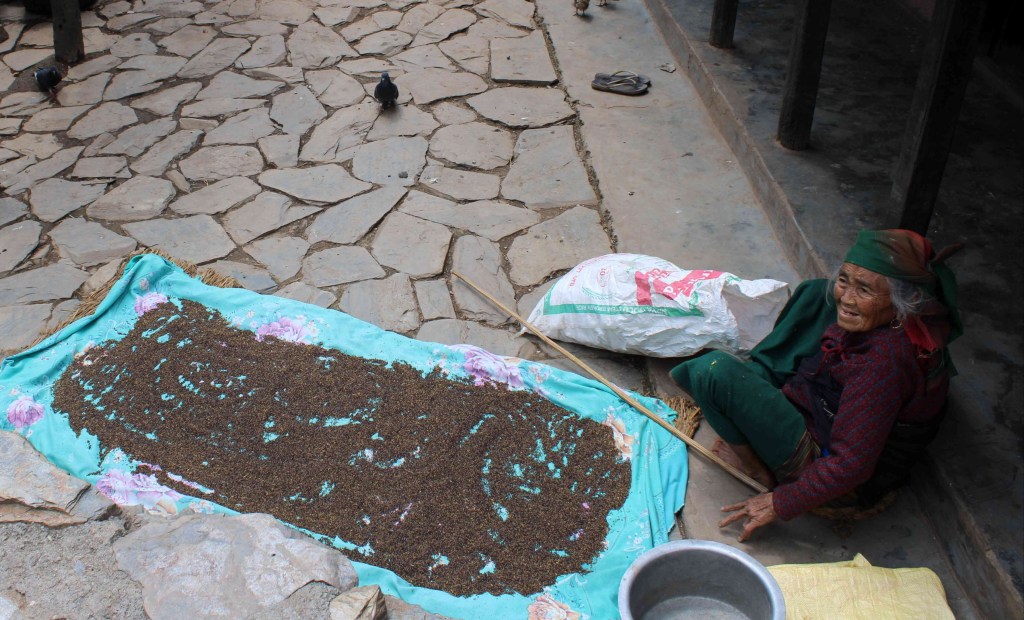
Further on, at the bend of an alley, we exchange a few words with another woman. She finds the time long while her family is busy in the fields.

She supervises the drying of the mustard seeds, chasing away with her long wand the pigeons who cast envious glances at this providential manna.
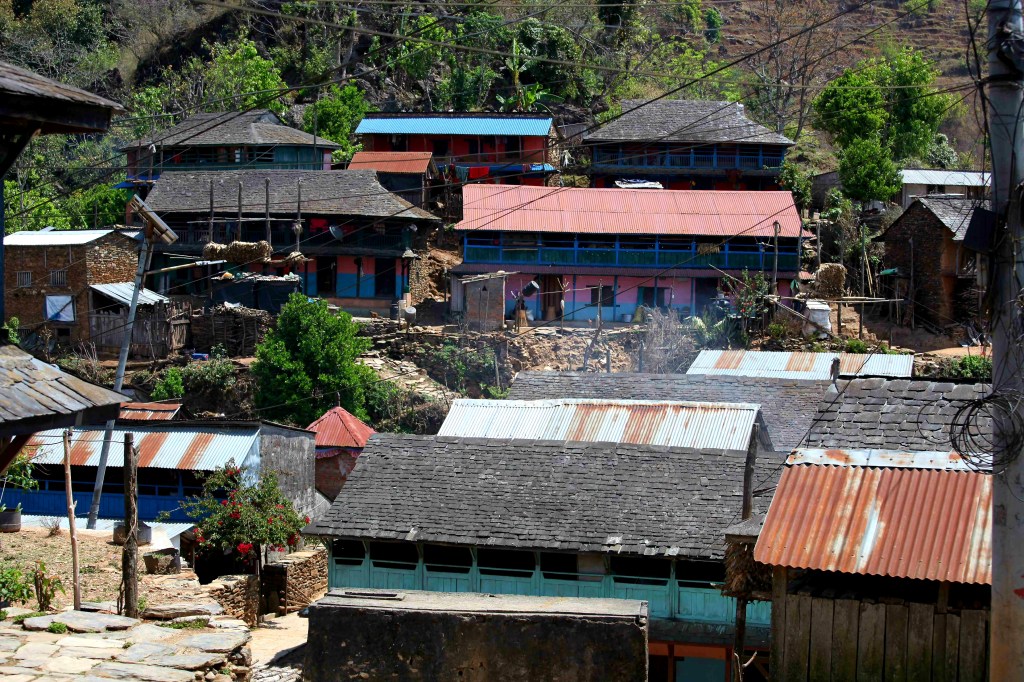
It’s easy to imagine that here, in the cold season or the rainy season, the days can seem long, as an old peasant couple explains to us. Our Western minds, saturated with noise and proposals for occupation, readily welcome the peace that reigns here. It is an atmosphere of meditation that we particularly appreciate after the tumult of Kathmandu. A true school of peace and the beginnings of a change of direction for our personal lives.

On the way back, at the bottom, we see the school and right next to it a couple of farmers who are leading the buffaloes for plowing.

It is hot and dry. Only a few trees provide a touch of greenery and at this time, shaded areas are rare.

If we pay close attention, we see that there is no shortage of activity on the espaliers. It’s magical and we never stop contemplating it.

Nature shaped by the hands of men and the work of buffaloes offers us something to delight in at every turn of the mountain. And that’s fortunate because the pain in my right leg is getting more and more throbbing… I have to occupy my mind to move forward without paying too much attention to it.
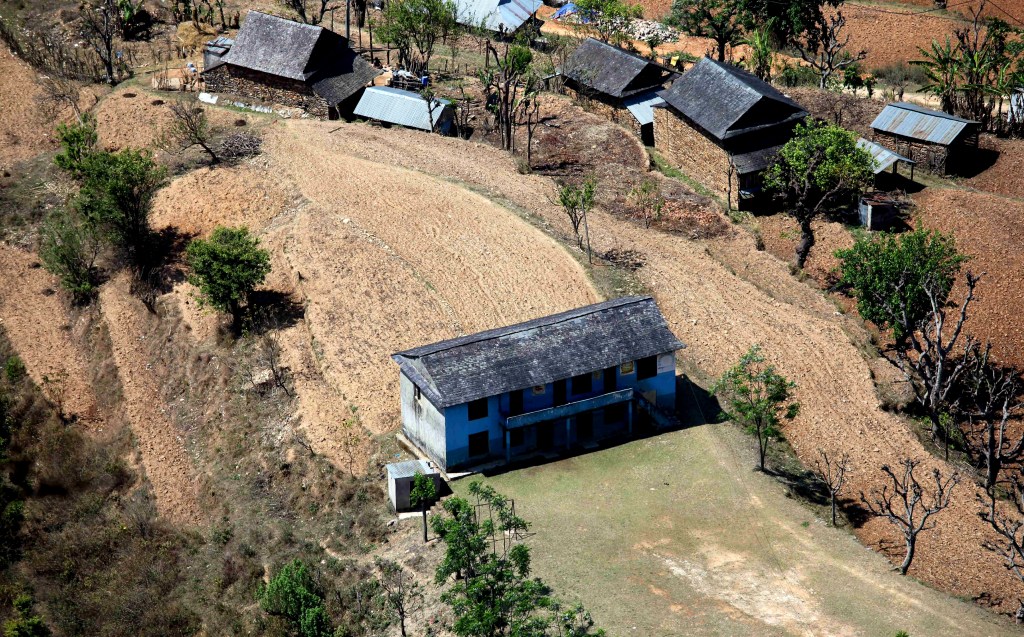
Also, he wanders from one dwelling to another, from one corner of the valley to the other. He jumps from one espalier to another, stops there for a moment, then returns to the path, then flies away for a moment into the blue sky… these incessant wanderings allow me to distract myself from the tensions that arise. settle into the muscles as the descent begins.

At every turn, new discoveries. We could spend the whole day observing the activity of the farmers in this corner of the mountain. There is a great closeness between the inhabitants of this region and nature.
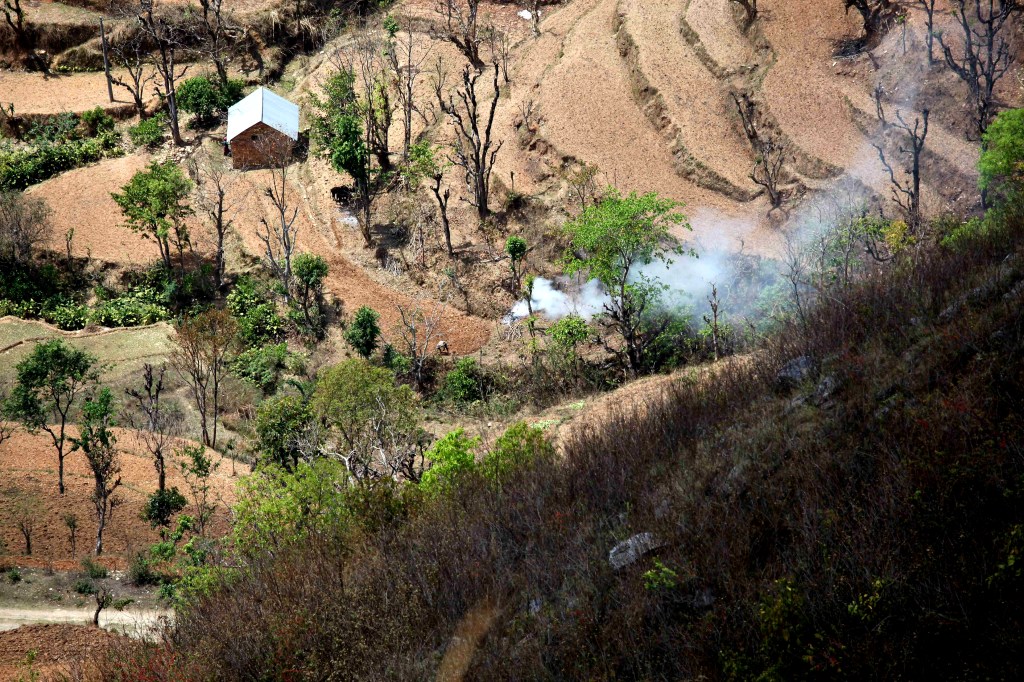
Some farmers light fires in the mountains, to weed and so that the animals can benefit from the first regrowth. It’s dangerous and forbidden but it happens regularly nonetheless.

Sitting in the middle of espalier crops, a man meditates and rests.
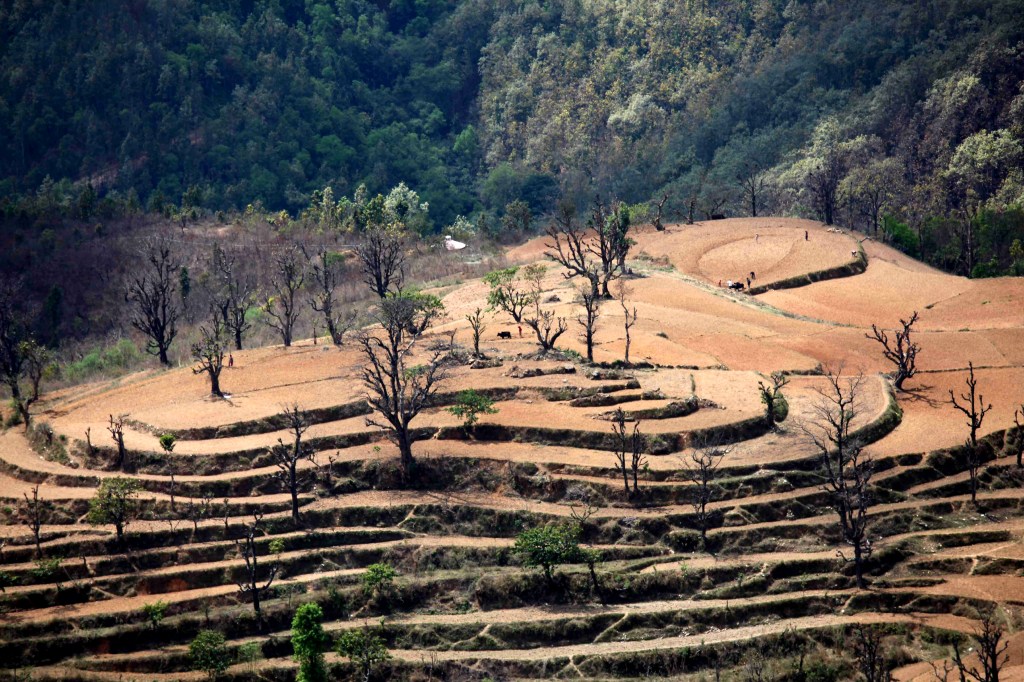
A little further down, people work in small groups. This culture and this way of living is something fascinating.

The leg tenses more and more despite alternate breathing, walking slows down. Roshan is patient and also slows down his pace because you will have to reach the end of the path on foot. Here, we rarely come across a vehicle.

It’s time to do some stretching if I want to continue until the end, especially since the sun is now clearly setting in and a big storm is forecast for the end of the day.

Jean-Yves and Roshan take advantage of my stretching breaks for a few discussions and some photographs. We look forward to sharing good times with Roshan and his superb smile.
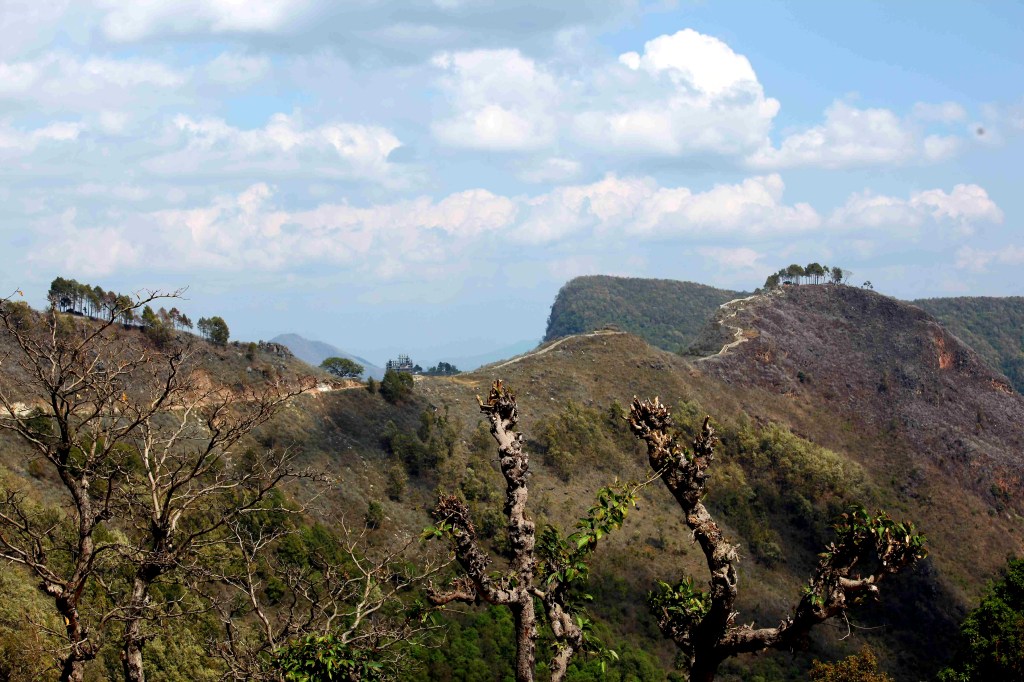
Roshan presents to us the Bandipur wall project which hopes to one day rival the Great Wall of China!

He shows us that the school in which he is teaching this year is not located there, but two hours’ walk away, on the other side of the valley, on the other slope. He goes there every day.

And now, around a bend, the village of Bandipur finally appears. On the left, a hotel is being built as well as a cable car to reach it from the valley, we find that it is a shame for the authenticity of the place… Roshan, just like us, fears the arrival a much less green and less ethical tourism. The last meters to the village are done slowly because my right leg now refuses to bend. I need to carve two makeshift sticks and find some tips to keep going down. But above all I have to let my mind continue to wander from valley to valley, this helps me to think less about the pain… We finally arrive in Bandipur just a quarter of an hour before the very big storm predicted. Good stretching, as well as a hot shower, quickly overcome the tightness in my leg. A good night’s sleep, and I’ll be ready for the trek. And that day I won’t forget to take my walking poles for the descents! We can’t wait to discover the Annapurna balcony and meet the local people. A huge thank you to Roshan for this first initiation to discovering the mountains and meeting such beautiful people.
By Nathalie et Jean-Yves
 Rencontres et découvertes, ici et ailleurs